

Your Job Is A Single Point Of Failure
I don’t want a job because I don’t want 100% of my revenue in the same basket. Especially when the basket is owned by somebody else.

By Mark Whitney
As an end user of good writing, I know that whenever there’s a layoff at some big news operation I am in for a treat. See, e.g. You Can’t Kill Swagger: My old corner of The Washington Post raised some of the best journalists in the business by Sally Jenkins; How Jeff Bezos Broke The Washington Post: The paper of record for the nation’s capital cut a third of its staff this week. It didn’t have to be like this. by Hanna Rosin.
Sally and Hanna are 65 and 55, respectively. They have forgotten more about writing than I will ever know.
But, if I’ve learned one thing about myself at 66 it is this: The reason I am an entrepreneur is my low tolerance for risk. This was especially true when my children were counting on me for essentials like food and shelter, and upgrades like skiing, go-carts, figure skating, flying lessons, and private school.
I had a dozen jobs during the four years my wife was in college studying for one. I quit six and was fired from the other half. Five of those jobs were at two radio stations and three TV stations.
One of the radio stations was in Middlebury, Vermont. At 19 I was actually getting paid to run my mouth on the air. Running my mouth is what I was born to do, and at one level or another, I’ve been running my mouth ever since. But that’s not why I called.
We had a couple of guys who actually supported their families selling advertising for this tiny station in a town of 7,000 people. This was commission sales, which means the advertising had to be expensive enough to pay the sales guy, the on-air staff, the office staff, the program director, the engineers, and the owner.
If you owned an AM/FM setup in 1978, you needed a swamp for the AM transmitter. For an FM station, you needed a mountaintop and snowmobiles for the FM transmitter.
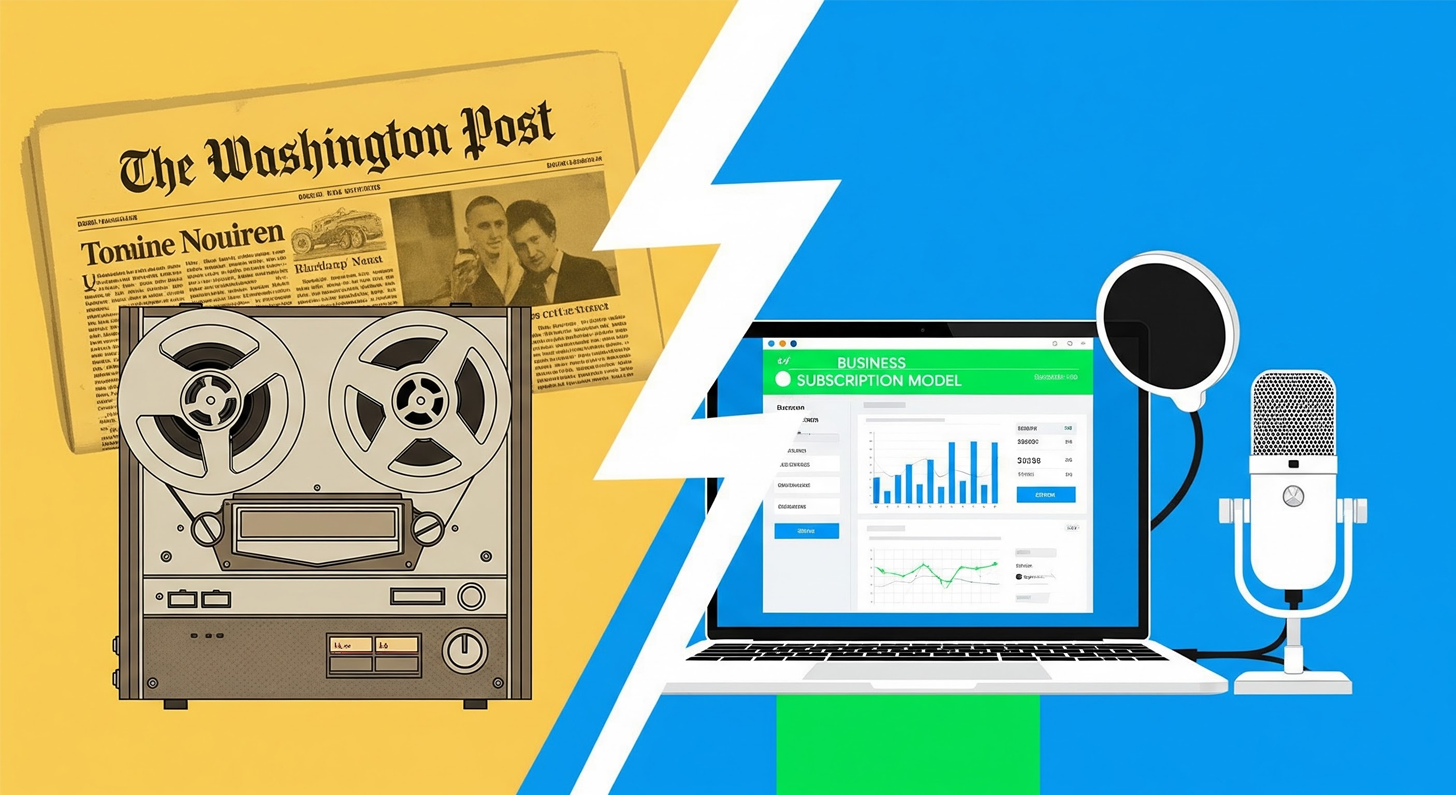
During my on-air shifts I ran both stations at the same time. On the AM side I was live. On the FM side, I pre-recorded newsbreaks, sports updates, and weather forecasts, for playback on a rack of four, semi-autonomous 1/4-inch reel-to-reel tape machines, containing latest hits which were shipped to us once a week from a subscription service via UPS.
In 1978, the only way to know this week’s #1 song was to listen to Casey Kasem’s American Top 40. After he retired, Casey was replaced by Radio Hall Of Famer, Shadoe Stevens, whose credentials include hosting Hollywood Squares, being the house announcer for Craig Ferguson’s late night show, and the house announcer for, Late Nite Last Week, the smash hit of a podcast which I created, produced, wrote, and hosted for four seasons from 2016-2019.1
From The Archives: 2019 Late Night Comedy Awards · Joke Of The Year
If you owned a radio station like the one I worked at in 1979, it was a valuable asset. You could sell it for a lot of money. You don’t want to own a station like this today, just as you do not want to own The Washington Post.
When Mom wanted to hear me on the radio, she had to drive ten miles from the other side of the mountain, to the parking lot of the Middlebury Snow Bowl. When she turned on the radio, there we were: Me and static.
All of that expense, transmitters, and engineers—and if you were outside a 10-mile radius, you had no way of knowing this little radio station existed.
In 2011, when I wanted Shadoe as a house announcer on my first of several failed podcasts, I sent him an email: “Yo, Shadoe! Whassup?! Long time listener. First time caller.”
We made a deal. No middle man. No gatekeepers. No permission slips. No editors. No advertising staff. No engineers.
We are the owners. We do all this from our personal, static-free, digital sound studios, as do hundreds of thousands of folks from around the world.
Be honest.
Would you invest in The Washington Post as a business model? Will the Post even exist five years from now? What if it doesn’t?
Stay honest.
Google is essential. Amazon is essential. The Post is disposable.
I don’t want a job because I don’t want 100% of my revenue in the same basket. Especially when the basket is owned by somebody else.
I much prefer B2B subscription businesses like the legal research infomediary I founded in 1999, and which over the years amassed 40,000 subscribers. A subscription is $495 annually. Subscribers come and go. Do I care? I do not.
I especially appreciate Sally Jenkins.2 But, consider the opening salvo from her piece in The Atlantic, that I linked to above.
“On a frigid white January afternoon in 1982, an airplane took off from Ronald Reagan Washington National Airport for Florida, remained aloft for about 30 seconds, and then stalled out and collided with the 14th Street Bridge, plunging into the ice-floe-studded waters of the Potomac River. In The Washington Post’s newsroom, an aghast 24-year-old college-basketball reporter named Michael Wilbon watched live reports of the disaster on the mounted TV banks, heard the urgency among those around him, grabbed a notebook and his jacket, and ran toward the riverbank to report on the rescue efforts, because that was what he’d been schooled to do.”
If this happened today, by the time Wilbon arrives on the scene, it’s too late. Video of the crash, from every conceivable angle, is already viral. Podcasters are firing up their cameras and pulling up to their SM7s. Substackers are cranking out think pieces. “How The Crash Impacts My Lived Experience As A Person Who Once Saw The Potomac On A Ninth Grade Field Trip.”
Jenkins is nostalgic. I get it. Nostalgia is a powerful human emotion. In your sixties you spend more time building upon the rear view mirror, than imagining what’s in front of you.
The challenge is to create a reliable, forward path. For me, since 1995, that path has been intentionally defined by thousands of individuals and organizations, each paying me a little bit of money, thereby freeing me to run my mouth on stage and screen, as I was born to do.
♫So a job I’m getting, possibly,
I wonder who my boss’ll be?
I wonder if he’ll take to me...?
What bonuses he’ll make to me...?
I’ll start at eight and finish late,
At normal rate, and all, but wait!
I think I’d better think it out again.♫
2019 Late Night Comedy Awards · Interview of the Year: Lady Gaga (Winner); Nicki Minaj (Second Runner-up and Winner of Guest of the Year with a Vagina); Drew Barrymore (Runner-up). Guest of the Year with a Penis: Kevin Nealon (Winner); Tom Segura (Runner-up); Seth Rogen (Second Runner-up). Stand-up Performance of the Year: Arpana Nanshariya (Runner-up); Sam Morrell (Second Runner-up); Mark Norman (Third Runner-up); Kiri Shabazz (Fourth Runner-up); Sean Donnelly (Fifth Runner-up). Pun of the Year: Stormy Daniels (Winner); Conan O’Brien & Stephen Colbert (Runner-up, tie); Steve Higgins (Third Runner-up). Fail of the Year: Seth Meyers (Winner); Jimmy Kimmel (Runner-up); Norm MacDonald, Stephen Colbert, and Bill Maher (Second Runner-up); Steve Higgins (Third Runner-up). Joke of the Year: Michelle Wolfe (Winner); John Mulaney (Second Runner-up); Martha Stewart & Stephen Colbert (Third Runner-up); Trevor Noah (Fourth Runner-up); Colin Jost (Fifth Runner-up); James Corden (Sixth Runner-up); Bill Maher (Seventh and Ninth Runner-up); Seth Meyer (Eighth Runner-up).
Jenkins book, The Right Call: What Sports Teaches Us About Work and Life, is a singular work.